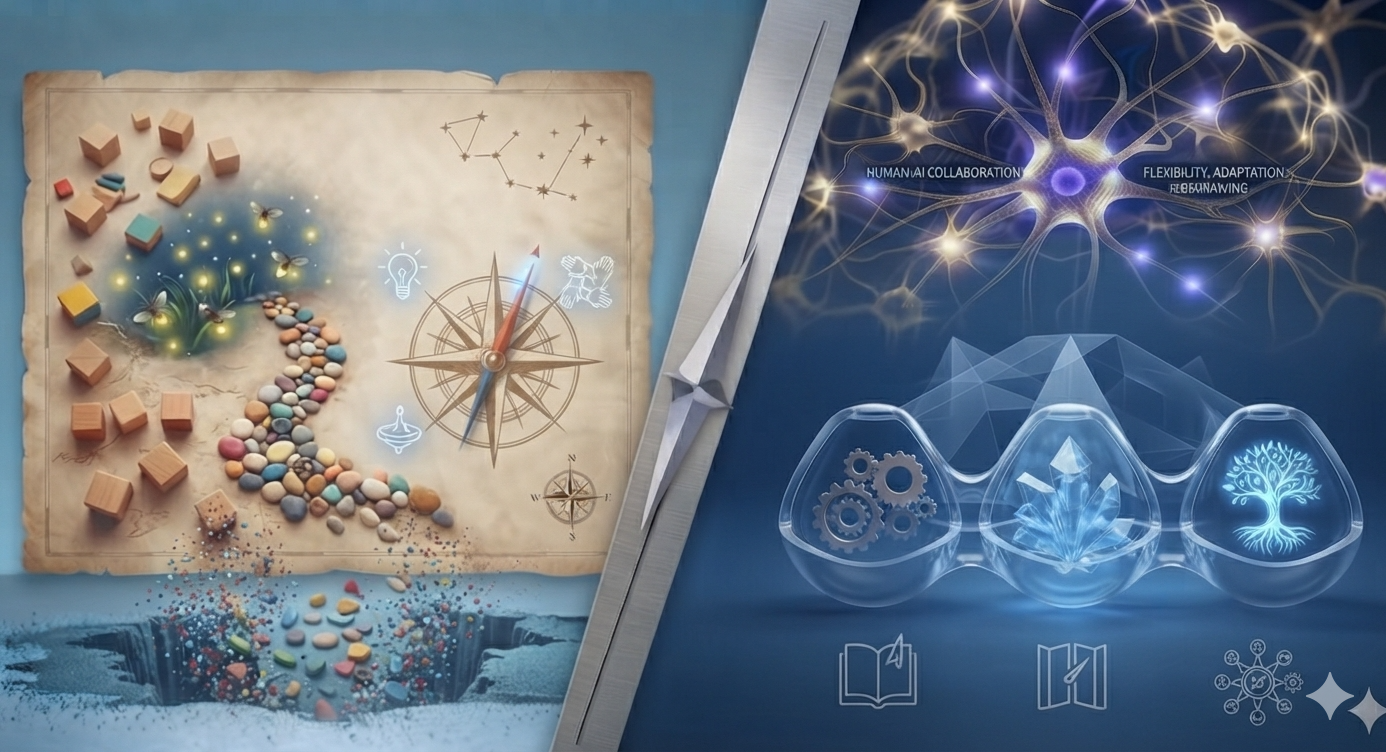
Motivation Is Not a Switch: What the Research Says About What Actually Drives Children
Four fixed directions, and a north that keeps moving from kindergarten through high school
Fifth article in the "The Biology of Education" series
Every week, in every classroom and every home, an enormous amount of energy goes into moving children from one place to another. Stickers. Progress charts. Promises. Screen time taken away. Conversations that start with "you have to understand this is for your own future". Some of these efforts work. Some do nothing at all. And some, and this is the part worth pausing on, cause damage that lasts for years after the sticker has peeled off.
This article is written for teachers and parents, and it draws on decades of research in developmental psychology, neuroscience and education. The central conclusion is easy to state and hard to swallow: motivation is not a switch with two settings, on and off. It is not a single slider running from "has it" to "doesn't have it" either. It is a multi-axis system that shifts as a child's brain, social world and emotional life mature.
🧭 When children "lose motivation", in most cases the needle did not break. North moved, and we kept navigating with the old map.
The motivation compass: four axes present at every age. What changes is which one pulls hardest.
Part One: The Four Axes of the Compass
To work with motivation rather than just talk about it, you first have to lay it out along four axes.
Source: internal or external
Is the activity done for its own sake, out of enjoyment or curiosity, or for an outcome separate from it: a prize, a grade, quiet from the parents.
Direction: mastery or proof
Is the goal to get better at something, or to prove ability to others. The difference looks small until the moment of failure: a child who came to improve responds to difficulty by changing approach. A child who came to prove responds to the same difficulty by collapsing, because the difficulty feels like evidence against them.
Ownership: owned or controlled
Does the action feel like my own choice, or like something imposed from outside: pressure, guilt, compliance.
Meaning: fun or purpose
Does the drive rest on immediate enjoyment, or on a longer-term connection: "this matters to who I am becoming".
All four axes exist at every age, from preschool through high school. What changes, and changes dramatically, is which one pulls hardest at each stage. Now let us walk through the stops.
Part Two: Three Stops Along the Way
First stop, ages 3 to 7: exploration, play and safety
What is happening inside. Thinking is still concrete, tied to the senses and to immediate results: I touched it → something happened. Imagination is at its peak, attention span is short. The prefrontal cortex, the region responsible for planning and delaying gratification, is only beginning to develop, so decisions are governed by emotion, novelty, and the presence of the closest adults. The developmental task of this age: initiative. Acting on the world without fear of getting it wrong.
What drives from the inside
- Curiosity through the hands: blocks, paint, mud, stories. The world gets explored through touch and play.
- Safety in the relationship: motivation grows out of feeling protected and connected to a parent or teacher.
- The joy of "I made that happen": the immediate experience of cause and effect. I pressed the button → a sound came out.
What helps from the outside
- Immediate, frequent feedback: verbal, visual, physical. Now, not at the end of the week.
- Playful routines and visible cues: an illustrated step chart, a clean-up song, a sticker board.
- Warm praise tied to effort: "I saw how hard you worked on that puzzle".
What kills motivation at this age: over-control and shame
When we manage a child's play step by step, or scold them for mistakes, anxiety and guilt take hold and they retreat into passivity. At exactly the age when they should be learning to initiate.
Second stop, ages 8 to 12: competence, levels and the sideways glance
What is happening inside. Logical thinking develops, understanding of rules and systems settles in, and the brain's reward system becomes sensitive to two new things: progress in skill, and position within the group. The developmental task: industry. Children are no longer asking only whether something is fun. They are asking how well they are doing at it, and where they stand relative to everyone else.
What drives from the inside
- A sense of competence: "math is going well for me", "that bug doesn't scare me anymore".
- First independence: choice within a frame. Not what to learn, but how to present what was learned.
- Enjoyment of graded challenge: difficulty that rises step by step and stays within reach. Not too easy, not impossible.
What helps from the outside
- Structured gamification: points, levels, progress bars, badges, clear rules.
- Social recognition: praise from friends and from adults the child respects, a sense of belonging to the group.
- Feedback that carries information: feedback about the approach and the effort, not about "talent".
What kills motivation at this age: the inferiority trap and the fixed label
"He's the smart one", "she's not a math person". Once ability is seen as fixed, any effort that does not succeed straight away becomes a threat. And the fear of looking like a failure in front of friends leads to a sad conclusion: better not to try at all.
Third stop, ages 13 to 18: independence, identity and purpose
What is happening inside. Abstract thinking matures, and with it the ability to picture yourself in the future. But an adolescent brain is not an "unfinished adult brain". It is a system with a built-in imbalance: the social and emotional machinery is already running at full power, while the control and planning machinery is still under renovation. The result: enormous sensitivity to social standing, to threats against independence, and to adult insincerity, alongside low sensitivity to distant, abstract promises. The question that runs everything: "who am I, and why does what I do matter at all".
What drives from the inside
- Full ownership: over the goals, the pace and the execution. A direct order triggers automatic resistance, not out of rudeness but out of biology.
- Connection to identity: "this chemistry is my ticket into marine biology".
- Purpose: wanting the work to have an impact beyond the classroom and the grade.
What helps from the outside
- Social capital: teamwork, recognition from peers, a real audience for the work: publishing, competing, presenting to outsiders.
- Mentoring instead of commanding: a coaching relationship built on mutual respect, not instructions from above.
- Real usefulness: hands-on experience in the world, building a portfolio, projects with impact.
What kills motivation at this age: suffocation and pretence
Excessive control, tasks framed as "just do it for the test", and rewards that feel condescending. Each one of these erases internal interest, and all three together erase it completely.
Not teenagers who broke down → a map that was never updated.
Part Three: The Compass Table, the Whole Picture at a Glance
| Dimension | Ages 3 to 7 | Ages 8 to 12 | Ages 13 to 18 |
|---|---|---|---|
| Primary internal driver | Curiosity, play, security in the relationship | Competence, skill mastery | Independence, identity, purpose |
| External support that works | Visual charts, immediate praise, small tangible rewards | Structured gamification, levels, peer recognition | Personal mentoring, social standing, real impact |
| Where north sits | Play and belonging | Competence and standing | Ownership and meaning |
| Friction point | Transitions between activities, emotional overload | Fear of failure, comparison to others | Loss of independence, pointless busywork |
Part Four: How to Work the Compass, Four Switches
That was the diagnosis. Now the tools. The research points to four needs that, when met, generate high-quality motivation from the inside, with no one having to inject it from outside.
Switch 1: Independence, control over the process
3 to 7: bounded choice. Not "what would you like to do", but two or three options that all work for you. "Are we writing the words in marker or in chalk?"
8 to 12: choice of route. Your goal, their path. "Here is the historical event. You can write about it, build it in Minecraft, or record an explanation."
13 to 18: partnership on goals and schedule. "What is your target for this term? Let's build a weekly plan together that fits your routine."
Switch 2: Competence, precise challenge and visible progress
The guiding rule: the task has to sit in the gap between what children can do alone and what they can do with help. Below that gap there is boredom. Above it there is paralysis. Inside it there is learning.
3 to 7: progress you can touch. A paper chain where each link stands for five minutes of reading.
8 to 12: a ladder of levels and an easy entry point. Break the topic into levels and use the five-minute rule: "just do level 1". Getting stuck breaks at the entry, not at the persistence.
13 to 18: feedback on the approach, not the talent. Not "you're smart", but "isolating the unknown first is what solved that problem". The first phrasing produces fragility. The second produces resilience.
Switch 3: Belonging, who is with me when it gets hard
The most neglected direction in conversations about motivation, and the one that holds all the others up when a task gets difficult.
3 to 7: shared presence. An adult sitting nearby doing their own work. Not supervision → presence. That is the whole difference.
8 to 12: shared goals. Group work where each child has a defined role. A steady study partner.
13 to 18: a real audience and mentoring. Teenagers teaching middle schoolers, presenting a project to outside guests, studying alongside friends. The social reward system runs at full power at this age. You can fight it, or you can harness it.
Switch 4: Meaning, why any of this matters
3 to 7: story and play. At this age meaning is the story. "We are space detectives decoding these symbols."
8 to 12: a real problem. Working out what it costs to build a doghouse is not an illustration of math. It is math.
13 to 18: usefulness and identity. "How does getting good at data analysis bring you closer to the system you want to build?" That question works. "Because it's on the exam" does not.
Part Five: Three Strategies That Work at Home and in Class
Strategy 1: The rule about rewards, and when they actually do harm
Here sits one of the most surprising and most replicated findings in motivation research: a tangible reward for an activity children already enjoy damages their internal motivation for it. It does not just fail to add, it subtracts, and the effect remains after the reward is gone. The brain runs a quiet calculation: if someone has to pay me for this, it probably isn't something you do for its own sake.
What happens to internal motivation when a reward is added
A schematic view of the overjustification finding: the damage shows up precisely after the reward stops.
So the rule has two halves:
Reward only tasks that hold no interest to begin with
Memorising times tables, tidying the desk, repetitive technical drilling. There is no internal motivation there to destroy.
Make the reward informational, not controlling
"If you study, you get a treat" is a control deal, and that is the harmful one. "I saw you focused for half an hour straight, let's celebrate that at break" is feedback on competence, and it builds.
The first tells children: this task is so bad you need compensating for it.
The second tells them: you are capable, and it shows.
Strategy 2: The four-step learning loop
All four switches can be folded into a single learning routine that repeats itself.
- Spark. Open with a curious question or a concrete problem, not with "turn to page 47".
- Small step. Break the task into short sprints, sized by age: about ten minutes for the youngest, about twenty for the middle years, up to 45 minutes for teenagers.
- Feedback. Talk about the approach, the effort and the persistence. Not about speed and not about "being clever".
- Reflection. At the end of the session, one question: "what approach helped you when you got stuck on step 3?"
Strategy 3: A toolkit by age
Four Questions to Ask Tomorrow Morning
Before your next conversation with a child who is stuck, run through these four. They point you toward the direction that is missing, instead of pushing harder on the one that is already full.
Independence
Does this child have any say over what, how, when or with whom they learn?
Competence
Is the task pitched at the right level, and is there a way for them to see their own progress?
Belonging
Who is beside them when it gets hard? Is there one human connection attached to this learning?
Meaning
If we asked them why they are doing this, would the answer come in the language of their age: play → skill → identity?
📌 The question worth avoiding is "why has this child got no motivation". It has never led anyone anywhere.
Summary
Motivation is not a trait you either have or lack, and not a switch you flip with a prize. It is a compass with four fixed directions: independence, competence, belonging and meaning. And its north moves at least three times on the way from kindergarten to high school: from play and safety, through competence and standing, to identity and purpose.
The tools have to move with it. Bounded choice becomes partnership on goals. A paper chain becomes feedback on the approach. A parent's presence becomes a real audience. And a reward, which looks like the simplest tool of all, turns out to be the most dangerous one the moment you apply it to something a child already loves.
A child's north moves. The needle always works.
The only thing that needs updating is the map in our hands.
Bibliography
Bandura, A. (1997). Self-efficacy: The exercise of control. W. H. Freeman and Company.
Casey, B. J., Jones, R. M., & Hare, T. A. (2008). The adolescent brain. Annals of the New York Academy of Sciences.
Deci, E. L., Koestner, R., & Ryan, R. M. (1999). A meta-analytic review of experiments examining the effects of extrinsic rewards on intrinsic motivation. Psychological Bulletin.
Dweck, C. S., & Leggett, E. L. (1988). A social-cognitive approach to motivation and personality. Psychological Review.
Eccles, J. S., & Wigfield, A. (2002). Motivational beliefs, values, and goals. Annual Review of Psychology.
Erikson, E. H. (1968). Identity: Youth and crisis. W. W. Norton & Company.
Piaget, J. (1952). The origins of intelligence in children. International Universities Press.
Ryan, R. M., & Deci, E. L. (2000). Intrinsic and extrinsic motivations: Classic definitions and new directions. Contemporary Educational Psychology.
Vygotsky, L. S. (1978). Mind in society: The development of higher psychological processes. Harvard University Press.
Yeager, D. S., Henderson, M. D., Paunesku, D., Walton, G. M., D'Mello, S., Spitzer, B. J., & Duckworth, A. L. (2014). Boring but important: A self-transcendent purpose for learning fosters academic self-regulation. Journal of Personality and Social Psychology.
Let's keep the conversation going 💬
If there is a child in your classroom or your home who everyone has already agreed "just doesn't want to", we would love to hear what that looks like. These four directions show up differently in every child, and the hard cases are usually the ones that teach the most.
✉️ Write to us: [email protected]